










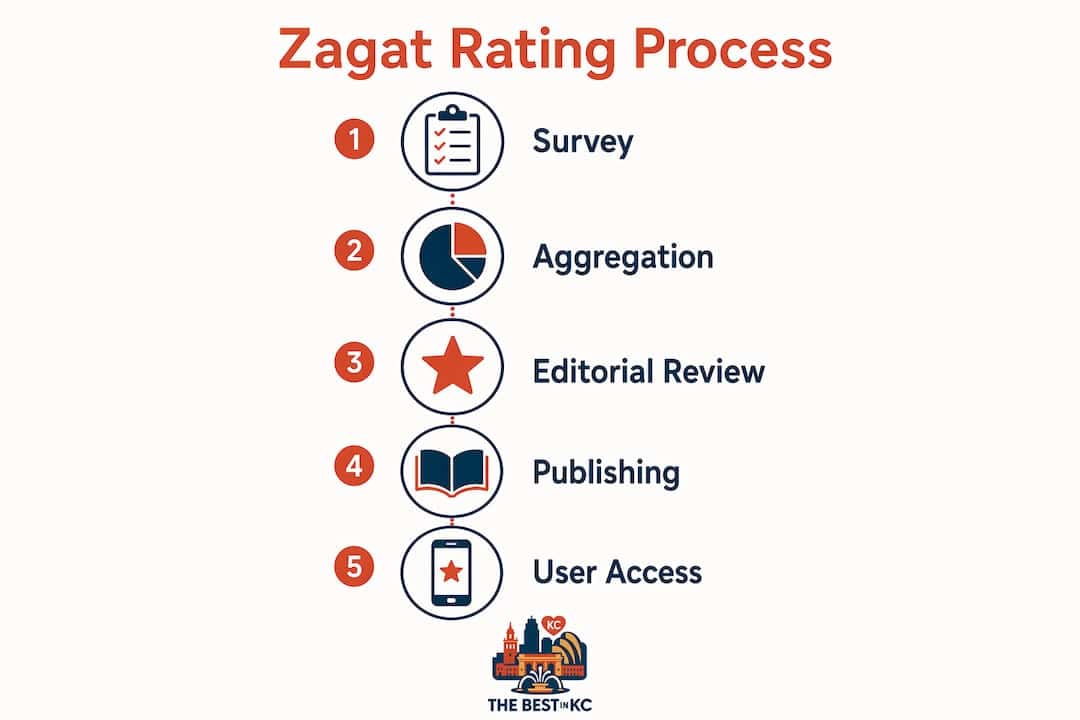
Zagat converts recent diner surveys into numeric scores across specific categories, then pairs those numbers with editor-curated comment snippets. The 10-point rating system launched in 2021 replaced the old 30-point scale and added a dedicated delivery/takeout category. Here’s what builds every Zagat score:
- Survey responses from diners who ate or ordered within the past 12 months
- Four scored categories: food, service, atmosphere, and delivery/takeout
- Aggregation of those responses into a decimal score per category
- Editorial curation where editors select and shape comment snippets to match the numeric profile
- Moderation that removes self-reviews and non-compliant submissions before publication
Table of Contents
- How does the Zagat scoring scale work?
- Who can submit a Zagat rating?
- How Zagat turns survey responses into published scores
- What changed in the 2021 relaunch?
- How does Zagat differ from other review platforms?
- How to read Zagat scores as a KC diner
- When should you trust Zagat scores, and when shouldn’t you?
- Key Takeaways
- Zagat scores are one tool, not the whole answer
- The Best in KC has the KC-specific shortlists Zagat can’t build
- Useful sources
How does the Zagat scoring scale work?
Zagat’s current scale runs from 0.0 to 10.0, displayed separately for each rating category rather than collapsed into a single star. That means a restaurant can score a 9.1 for food and a 6.8 for service, which tells you something a single aggregate number never could.
Each category score is an averaged result of qualified diner responses for that dimension alone. Higher scores in atmosphere typically signal a comfortable, well-regarded space without being exceptional. High food scores indicate a genuinely elite dining experience. For KC diners, the category breakdown is the most useful part of the Zagat score explanation, because a spot can absolutely nail burnt ends and still have indifferent service.
“By separately rating food, décor, service, and cost, we would give people a way to make smart decisions for themselves about what was most important to them.” — Nina Zagat, Vassar Alumnae/i Quarterly
The delivery/takeout category is graded independently, which matters when you’re deciding between dining in at a Westport spot or ordering from it on a Tuesday night.
Who can submit a Zagat rating?
Anyone with a valid email address who has eaten at or ordered from a venue within the past 12 months can submit a survey. Restaurant employees and representatives are barred from rating their own venues, and Zagat’s moderation actively enforces that rule.
The submission process runs like this:
- Request or receive a survey link from Zagat.
- Confirm your email address to validate participation.
- Rate the venue across each applicable category on the 0.0–10.0 scale.
- Add optional written comments (these feed the editorial curation process).
- Submit. Moderation typically clears submissions within approximately 24 hours.
One important limit: you can only submit one survey per venue per day. That keeps any single diner from flooding a restaurant’s score.
Pro Tip: Keep your written comment short and category-specific. “Brisket was perfectly smoky, served hot” is far more useful to editors than a paragraph about parking. Specific, single-topic comments are the ones most likely to appear in the curated summary.

How Zagat turns survey responses into published scores
Individual survey responses are averaged across all qualified submissions for a venue, producing the decimal category scores you see on the platform. The more responses a restaurant has, the more stable that average tends to be.
The written comments go through a separate editorial process. Editors select and shape user-submitted snippets to align with the numeric profile rather than publishing raw, full-length reviews. A restaurant scoring a 9.0 for food will have its summary built from comments that reflect excellent food, not outlier complaints.
Zagat’s editorial blurbs are not raw user quotes. They are selected and edited to match the numeric rating profile, which means outlier negative comments are unlikely to appear in a high-rated summary.
That editorial layer is both a strength and a limitation worth understanding. It produces clean, decision-friendly summaries. It also means the published blurb reflects a curated voice, not the full range of diner opinion. Tim and Nina Zagat built the model on the premise that aggregating many knowledgeable consumer voices produces a fairer result than any single critic, and the editorial curation is meant to make that aggregated data readable, not to distort it.
What changed in the 2021 relaunch?
The 2021 relaunch was the most significant update to Zagat’s presentation in decades. Here’s what shifted:
- Scale change: The old 30-point presentation gave way to the current 0.0–10.0 system, making scores immediately comparable to other rating formats most diners already use.
- New category: Delivery/takeout was added as a formally scored, standalone dimension, reflecting how fundamentally dining behavior changed during and after the pandemic.
- Workflow updates: The platform moved toward real-time survey collection rather than annual batch mailings, producing more current data.
- Stated mission: The relaunch announcement framed the changes as a way to support local restaurants and reflect present-day consumer dining behavior.
The 2021 relaunch positioned Zagat as a tool for supporting local restaurants and capturing how people actually eat now, including delivery and takeout as first-class dining formats.
The scale change matters practically. A score of 7.5 on the new 10-point system is not the same as a 7.5 out of 30 on the old one. If you’re reading older Zagat references for KC spots, check which era the score comes from.
How does Zagat differ from other review platforms?
The core difference is structural. Zagat relies on structured surveys and editorial curation rather than displaying full, unedited user reviews. What you read on Zagat is a distilled summary, not a feed of individual opinions.
“It wasn’t very useful to just have pages and pages of comments on a particular place. The most useful way to present this information is to curate the reviews, to pull together quotes from lots of different people based on the numerical ratings received.” — Nina Zagat
Mass-review platforms publish every submission in full, which gives you volume but requires you to sort through noise. Zagat’s compact, category-scored format is faster for quick comparisons across multiple restaurants. When you want to know whether a place scores higher on food or service, Zagat answers that in seconds.
Where longer reviews or local intel win: when you want to know whether a specific dish is still on the menu, whether a chef recently changed, or how a neighborhood spot feels on a Friday night. For that kind of granular, current detail, The Best in KC’s first-person lists are built exactly for it.
How to read Zagat scores as a KC diner
Zagat is most useful to me as one signal in a stack, not the whole answer. Here’s how I actually use it when picking somewhere to eat in Kansas City:
- 8.0–10.0 in food: Genuinely strong kitchen. Worth the trip even if the atmosphere score is middling.
- 6.0–7.9 in food: Solid and reliable. Good for a neighborhood dinner, probably not a special occasion.
- Below 6.0 in any category: Worth pausing on. Either a new venue with limited responses or a real consistency issue.
- Delivery/takeout score: Check this separately from the dine-in categories. A place with a 9.0 food score and a 5.5 delivery score probably doesn’t travel well.
- Atmosphere score: Especially useful when you’re picking a patio spot. Cross-reference with The Best in KC’s list of top KC restaurant patios for current, firsthand detail.
Pro Tip: For newer KC openings or small neighborhood spots, check how many responses the score is based on. A 9.2 from eight responses is far less reliable than a 7.8 from 200.
Pair Zagat’s food category score with local menu knowledge. If a spot is known for a specific dish, like the Z-Man at Joe’s Kansas City, the food score tells you the kitchen is consistent. For newer KC cuisine trends, The Best in KC’s emerging cuisine guide fills in what Zagat’s aggregate can’t capture.
When should you trust Zagat scores, and when shouldn’t you?
Zagat scores are most reliable for established restaurants with a large response base and stable operations. The false precision issue is real: a decimal like 7.6 looks exact, but it’s the result of averaging coarse vote inputs, so the difference between a 7.6 and a 7.8 is rarely meaningful.
Critics have noted that Zagat’s decimal scores can create an illusion of precision, since the underlying inputs have historically been coarse vote choices averaged and scaled to produce finer-looking numbers.
Common limitations to watch for in KC specifically:
- New openings: Scores from the first few months reflect a thin sample and can swing dramatically.
- Chef or ownership changes: Zagat scores lag real-world shifts. A restaurant that changed chefs six months ago may still carry scores from the previous kitchen.
- Delivery/takeout vs. dine-in: These are separate scores for a reason. Don’t assume a high food score means the delivery experience matches.
- Sample selection: Zagat’s historical methodology has drawn scrutiny for who participates, which can skew results toward certain dining demographics.
Seek additional local confirmation when: a restaurant recently changed management, a menu overhaul was announced, or the score is based on a small number of responses.
Key Takeaways
Zagat ratings are built from aggregated diner surveys, not individual critic opinions, and the 2021 relaunch made the system more accessible with a 0.0–10.0 scale and a dedicated delivery/takeout category.
| Point | Details |
|---|---|
| Current scale | Zagat uses a 0.0–10.0 scale per category, introduced in the 2021 relaunch. |
| Four scored categories | Food, service, atmosphere, and delivery/takeout are each scored independently. |
| Submission rules | Valid email, meal within the past 12 months, one survey per venue per day, moderated within ~24 hours. |
| Editorial curation | Editors select and shape comment snippets to match the numeric profile, not raw user text. |
| The Best in KC | Combines Zagat scores with first-person visits and local menu knowledge for KC-specific picks. |
Zagat scores are one tool, not the whole answer
Here’s my honest take after using Zagat alongside years of eating around Kansas City: the numeric category breakdown is genuinely useful, and the 2021 relaunch made it more readable. But the editorial curation is worth understanding clearly. The blurbs you read are not a representative sample of all diner opinion. They’re a curated selection that aligns with the score, which means a high-rated restaurant’s summary will read warmly even if a meaningful minority of diners had a different experience.
The delivery/takeout category is the most underrated addition from the relaunch. KC has a real delivery culture now, and a restaurant’s ability to hold up in a takeout container is genuinely different from its dine-in performance. Checking that score separately before ordering is a habit worth building.
What Zagat can’t do is tell you whether the patio at a Crossroads spot fills up by 6:30 PM on a Saturday, or whether the smoked chicken at a new East Side opening is worth the drive. That’s where local knowledge, first-person visits, and guides built by people who actually showed up make the difference. The numbers are a starting point, not the destination.
The Best in KC has the KC-specific shortlists Zagat can’t build
Zagat gives you a number. The Best in KC gives you the full picture: the exact dish to order, the right time to arrive, and whether the spot is worth crossing the state line for. Every list on The Best in KC is written by locals who’ve actually been there, with addresses, price signals, and the kind of detail you only get from showing up. For visitors planning a KC trip, the best attractions guide is the fastest way to build a real itinerary. Craving a specific bowl? The best pho in the KC metro is a first-person guide to every serious contender. Start there, then use Zagat to cross-check the numbers.
Useful sources
- The new Zagat relaunch announcement (PR Newswire) — Official 2021 relaunch statement covering the scale change and delivery/takeout category addition.
- Zagat restaurant survey tips and participation rules — Primary source for submission eligibility, category definitions, and the one-survey-per-day rule.
- Zagat FAQs — Covers employee exclusion policy and moderation practices.
- Analysis of Zagat’s scoring and perceived precision (Fine Dining Explorer) — Documents the false-precision critique and the historical coarse-input averaging method.
- Nina Zagat interview, Vassar Alumnae/i Quarterly — First-person account of the founders’ philosophy on democratic aggregation and editorial curation.
- The Zagat Effect, Commentary Magazine — Detailed critical analysis of sampling bias, editorial control, and score reliability.
- Zagat Restaurant Guides: Whose Voice Is Being Heard? (The New York Times) — Historical reporting on participant demographics and sampling concerns.