






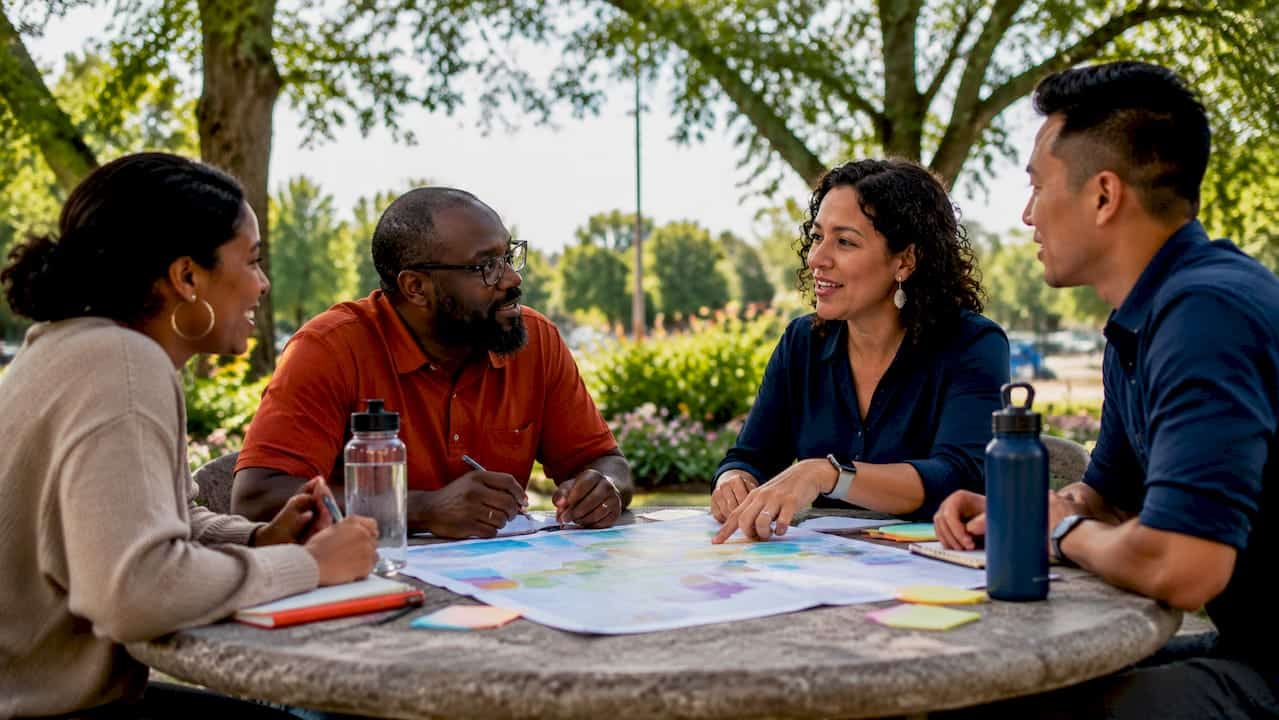
Neighborhood revitalization is defined as the deliberate, coordinated effort to improve under-resourced communities through physical upgrades, social programs, and economic investment that prioritize inclusion and long-term sustainability. Unlike older urban renewal models that bulldozed communities to rebuild them, modern revitalization keeps existing residents at the center of every decision. Programs like the AARP Community Challenge and initiatives guided by the U.S. Department of Housing and Urban Development (HUD) have made this approach a recognized standard in American urban planning. For community members and urban planners alike, understanding what drives neighborhood revitalization is the first step toward making it work.
What is neighborhood revitalization, and what does it actually involve?
Neighborhood revitalization is best understood as a systems-level process, not a single project. It addresses the physical, social, and economic conditions of a neighborhood at the same time, because fixing one without the others rarely produces lasting results. The Neighborhoods as Systems Toolkit describes this as systems thinking for change, where practitioners commit to transforming underlying social and economic systems rather than applying temporary surface fixes.
The physical side includes housing rehabilitation, streetscape improvements, park upgrades, and commercial corridor investment. These are the most visible signs of renewal and often the first things residents notice. But physical changes alone do not sustain a neighborhood. Long-term success depends on institutionalizing policies for healthcare access, education, and economic empowerment alongside any construction work.
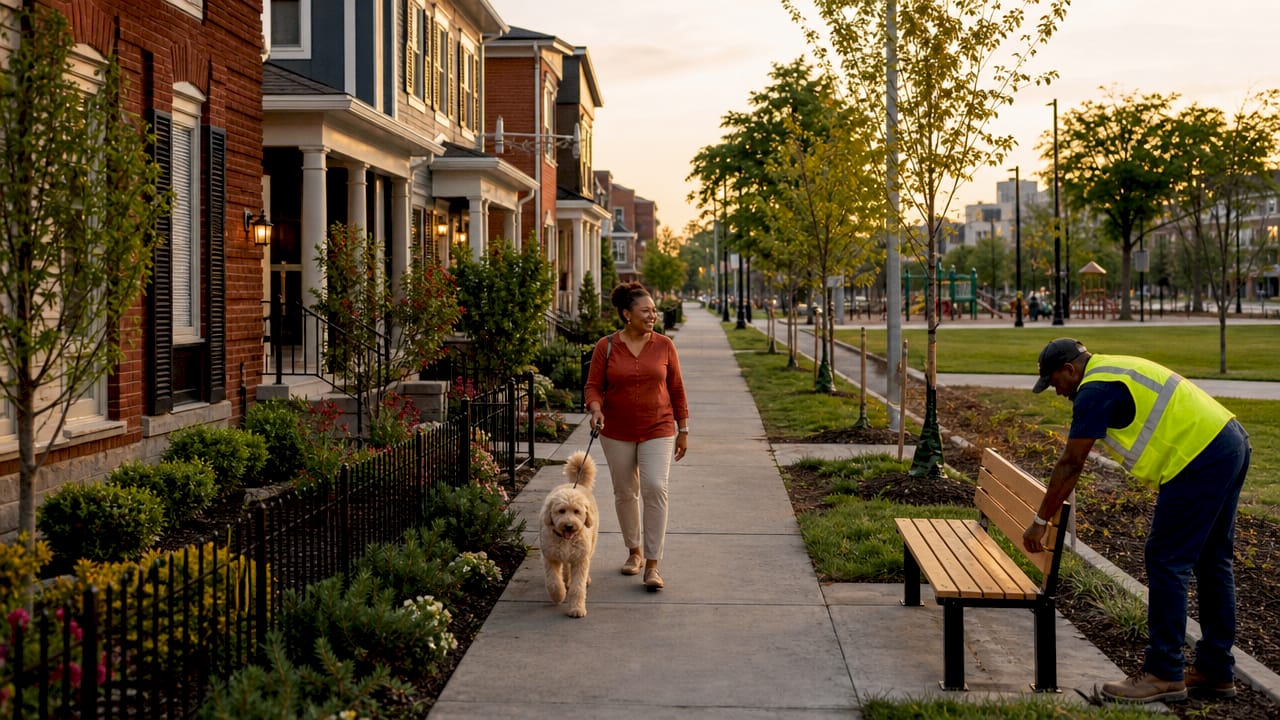
The economic and social dimensions are equally concrete. Community development programs bring job training, small business support, and affordable housing preservation into the same plan as sidewalk repairs and building renovations. This integrated approach is what separates modern neighborhood revitalization from the piecemeal urban improvement strategies of the past.
Key funding mechanisms that make revitalization possible
Funding is one of the most practical concerns for planners and community leaders. The AARP Community Challenge has invested $24.3 million across 2,100 projects since 2017, with annual funding often exceeding $8 million for quick-action infrastructure and livability improvements. That scale shows just how much national grant programs can accelerate local action.
State-level programs add another layer of support. Some offer small project grants ranging from $5,000 to $25,000, plus intensive technical assistance of up to 400 hours, guiding communities from initial assessment through full project implementation. That combination of money and expertise is what turns a neighborhood plan into a completed project.
Pro Tip: Apply for quick-action grants like the AARP Community Challenge before pursuing larger HUD funding. Smaller wins build credibility, demonstrate community support, and strengthen your case for bigger investments.
- Physical improvements: Housing rehab, streetscapes, parks, and commercial corridors
- Social programs: Education access, healthcare outreach, and workforce development
- Economic initiatives: Small business grants, job training, and affordable housing preservation
- Funding sources: National grants (AARP Community Challenge), state-level programs, HUD, and private philanthropy
- Technical assistance: Expert guidance from assessment through implementation, often provided at no cost to communities
How does neighborhood revitalization differ from traditional urban renewal?
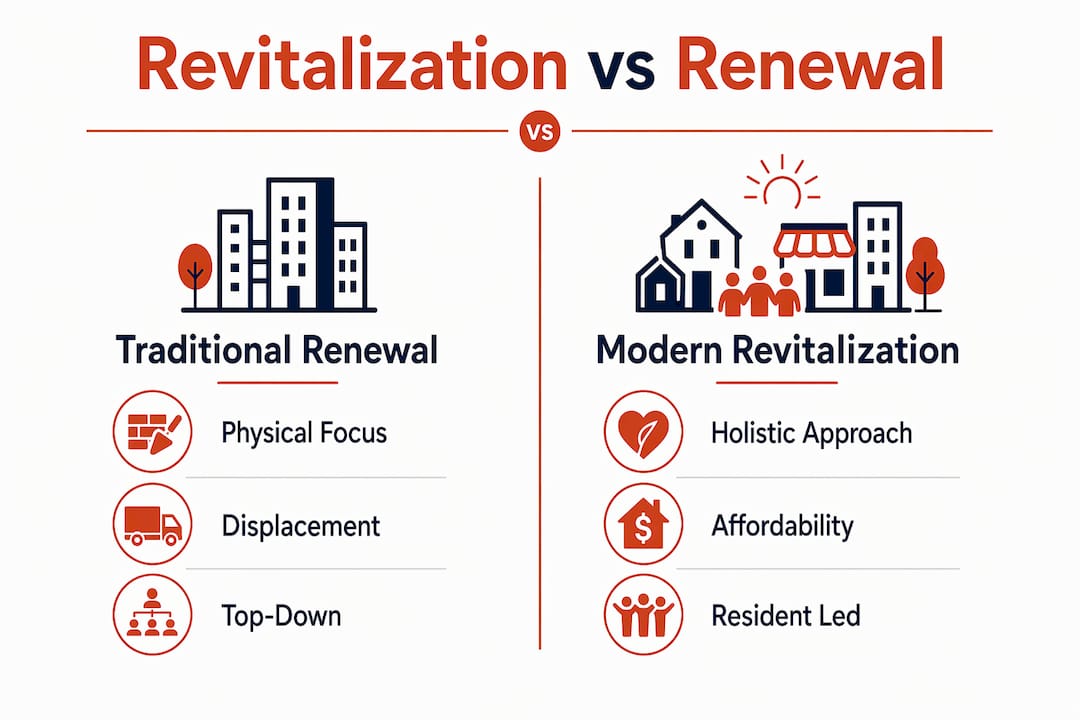
Urban renewal, as practiced widely from the 1950s through the 1970s, prioritized physical redevelopment above all else. City governments cleared entire blocks, often displacing thousands of low-income residents and communities of color, to build highways, stadiums, and commercial districts. The results were frequently devastating for the people who had lived there.
Modern neighborhood revitalization takes the opposite approach. Displacement is actively avoided by integrating economic, social, and environmental goals and by prioritizing the inclusion of existing residents in every phase of planning and implementation. The goal is to improve conditions for the people already there, not to replace them with a wealthier population.
| Feature | Traditional urban renewal | Modern neighborhood revitalization |
|---|---|---|
| Primary focus | Physical demolition and rebuilding | Integrated physical, social, and economic improvement |
| Resident role | Displaced or excluded | Central to planning and decision-making |
| Displacement | Common and often intentional | Actively prevented through affordability policies |
| Time horizon | Short-term construction projects | Long-term, adaptive commitment |
| Equity lens | Rarely applied | Built into every program component |
The shift toward resident leadership is not just ethical. It is also more effective. When communities shape their own revitalization plans, the results reflect actual needs rather than assumptions made by outside planners. Gentrification, where rising property values push out long-term residents, remains a real risk even in well-intentioned urban revitalization initiatives. Preventing it requires explicit affordability protections built into every stage of the plan.
Why does resident involvement make or break revitalization efforts?
Resident involvement is the single most reliable predictor of whether a neighborhood renewal project succeeds or fades after the ribbon cutting. Community trust and resident self-efficacy underpin durable improvements more than sheer financial investment alone. That finding comes directly from research on neighborhood action programs, and it holds up across cities of every size.
The concept of coproduction explains why. Coproduction positions local government as a partner rather than an enforcer, pairing code enforcement with genuine service provision to improve both the physical and social environment. Buffalo, New York’s Clean Sweeps program is a documented example. City crews worked alongside residents to clean lots, remove blight, and address safety concerns together, which built the kind of trust that keeps neighborhoods engaged long after the initial project ends.
Habitat Philadelphia’s work in the Sharswood Blumberg neighborhood shows what sustained resident partnership looks like at scale. A $750 million investment over 10 years reduced crime, diversified the population, and improved economic conditions. The investment worked because it was paired with continuous community engagement, not delivered to residents as a finished product.
Here is how to build authentic resident partnerships that last:
- Start with listening sessions before any planning begins. Residents know which problems are most urgent. Planners who skip this step consistently misallocate resources.
- Create visible feedback channels. When residents report a problem and see a response within days, their willingness to stay engaged increases significantly.
- Build resident leadership capacity. Train community members to lead working groups, manage small grants, and represent their neighborhood in public meetings.
- Measure and share progress publicly. Transparent reporting on outcomes builds credibility and keeps both residents and funders invested.
- Compensate community time. Stipends, childcare, and accessible meeting times signal that resident input is genuinely valued, not performative.
Pro Tip: Avoid one-time town halls as your primary engagement method. Ongoing neighborhood advisory committees with real decision-making authority produce far stronger results than periodic public comment periods.
What practical steps lead to sustainable neighborhood revitalization?
Sustainable revitalization does not happen by accident. It requires concentrated investment, cross-sector collaboration, and a long-term commitment to measuring outcomes and adjusting course. Concentrating investment in selected neighborhoods is more effective than spreading resources thin, driving measurable property appreciation and triggering growth across a city. Spreading the same dollars across too many areas produces visible results nowhere.
Atlanta’s approach under Mayor Andre Dickens demonstrates what cross-sector coordination looks like in practice. Atlanta’s targeted investments coordinate multiple public agencies to improve education, housing, and commercial corridors simultaneously while preserving affordability. No single agency drives the work. The power comes from alignment across government, nonprofits, and private partners working from a shared plan.
- Adopt systems thinking. Address root causes, not just symptoms. A new park does not fix a neighborhood with no jobs or failing schools.
- Concentrate resources. Pick two or three target areas and invest deeply before expanding.
- Integrate complementary services. Pair housing rehab with job training, healthcare outreach, and school improvement in the same geography.
- Leverage cross-sector partnerships. Government agencies, community development organizations, philanthropies, and private developers each bring resources the others lack.
- Preserve affordability from day one. Community land trusts, deed restrictions, and tenant protections must be in place before property values rise, not after.
- Track measurable outcomes. Crime rates, vacancy rates, median income, and school enrollment are concrete indicators that show whether the work is producing results.
| Strategy | Expected outcome |
|---|---|
| Concentrated investment | Measurable property appreciation and reduced vacancy |
| Cross-sector collaboration | Aligned resources across housing, education, and health |
| Resident-led planning | Higher program uptake and long-term community maintenance |
| Affordability protections | Reduced displacement as property values improve |
| Systems thinking approach | Durable change in social and economic conditions |
Key Takeaways
Neighborhood revitalization succeeds when concentrated investment, resident leadership, and long-term systems thinking work together in the same geography.
| Point | Details |
|---|---|
| Define it clearly | Revitalization combines physical, social, and economic improvements with inclusion at the center. |
| Fund strategically | National grants like AARP Community Challenge and state programs provide both money and expert guidance. |
| Avoid displacement | Build affordability protections into every phase before property values rise. |
| Prioritize coproduction | Resident-government partnerships produce more durable results than top-down programs. |
| Concentrate resources | Deep investment in fewer neighborhoods outperforms thin investment spread across many. |
What I have learned watching neighborhoods change
Watching Kansas City neighborhoods shift over the years has taught me one thing that no planning document captures well: the difference between a neighborhood that bounces back and one that stays stuck is almost never money. It is trust. Residents who have watched city crews show up, do visible work, and then disappear without follow-through stop reporting problems. They stop attending meetings. They stop believing the process works for them.
The most effective community development programs I have seen share a quality that is hard to quantify but easy to recognize. They treat residents as the experts on their own streets. The planners and funders bring resources and technical knowledge. The residents bring context, relationships, and the kind of institutional memory that no consultant can replicate. When those two things combine, the results are genuinely different.
I am also skeptical of revitalization plans that try to do everything everywhere at once. Spreading investment thin is the fastest way to produce a neighborhood that looks slightly better on paper but feels exactly the same to the people living there. Pick a block. Make it undeniably better. Then let that success pull resources toward the next block. That is how real momentum builds.
The uncomfortable truth is that sustainable neighborhood improvement takes longer than any election cycle. Politicians who want visible results in two years and residents who need change now are both right to feel frustrated. The answer is not to rush the process. It is to start earlier, stay longer, and measure honestly.
— Kevin
Kansas City neighborhood insights on Thebestkc
Kansas City is a city where neighborhood identity runs deep, and the difference between a thriving block and a struggling one is something locals feel every day. Thebestkc tracks what makes each KC neighborhood worth knowing, from the best local spots to the community anchors that keep streets alive. Whether you are a planner looking for ground-level context or a resident who wants to understand how your neighborhood stacks up, KC neighborhood rankings on Thebestkc give you a real, locally grounded starting point. The platform brings together the kind of place-specific knowledge that no city report quite captures.
FAQ
What is the main goal of neighborhood revitalization?
Neighborhood revitalization aims to improve living conditions and economic opportunity in under-resourced communities by combining physical upgrades with social and economic programs. The goal is lasting improvement for existing residents, not replacement of the population.
How does revitalization prevent gentrification and displacement?
Effective revitalization builds affordability protections such as community land trusts and deed restrictions into the plan before property values rise. Modern programs explicitly prioritize inclusion of existing residents at every stage of planning and implementation.
What role does community engagement play in revitalization success?
Resident involvement is the strongest predictor of long-term success. Research on programs like Buffalo’s Clean Sweeps shows that coproduction models, where residents and government work as partners, produce more durable neighborhood improvements than top-down approaches.
What funding sources support neighborhood revitalization projects?
The AARP Community Challenge has funded over 2,100 projects since 2017, and state-level programs offer grants from $5,000 to $25,000 plus technical assistance. HUD and private philanthropy also provide significant resources for community development programs.
How long does neighborhood revitalization typically take?
Sustainable revitalization is a long-term commitment, often spanning a decade or more. Philadelphia’s Sharswood Blumberg Transformation required a $750 million investment over 10 years to produce measurable reductions in crime and improvements in economic conditions.