
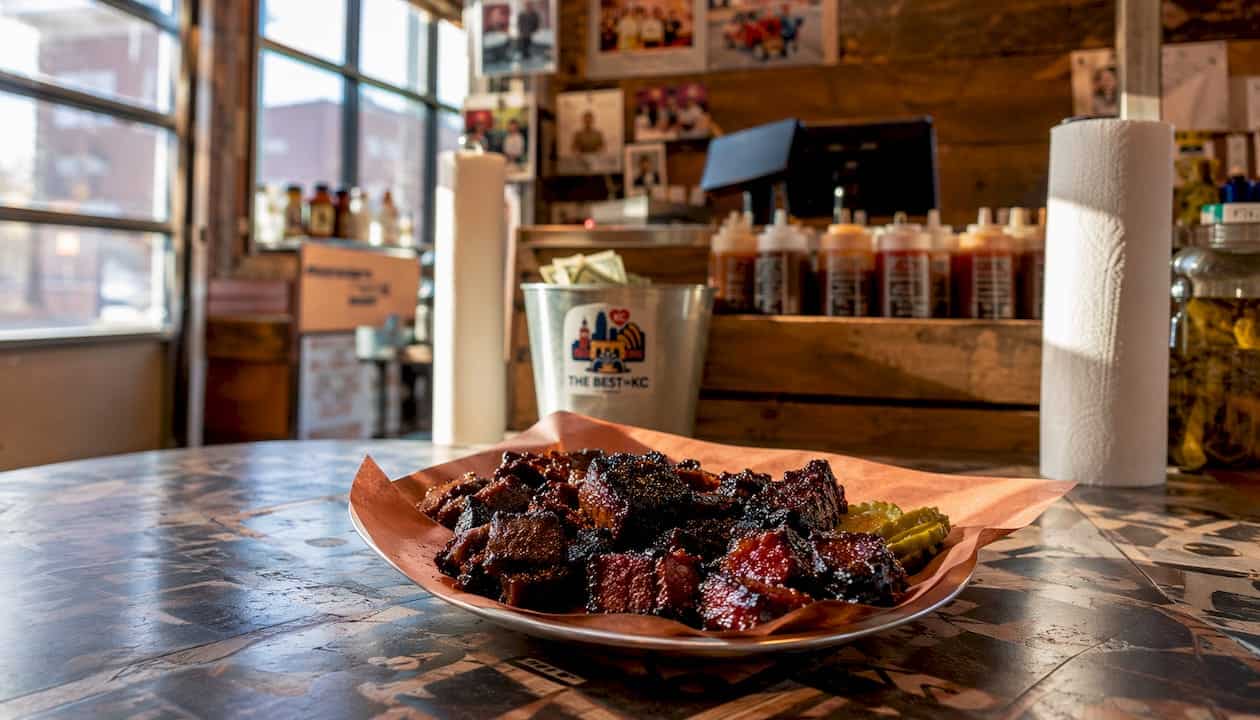
Kansas City’s signature dishes start with burnt ends, the pork tenderloin at Kitty’s Café, and the cheese slipper at Ibis Bakery. Beyond barbecue, the city claims the Z-Man sandwich, Dixon’s chili, Stroud’s fried chicken, and a handful of other dishes you genuinely cannot replicate anywhere else.
Quick reference for the examples of KC signature dishes covered below:
- Burnt ends at Joe’s Kansas City Bar-B-Que or Arthur Bryant’s Barbecue: slow-smoked brisket point, cubed, served without sauce
- Z-Man sandwich at Joe’s Kansas City: smoked beef, smoked provolone, caramelized onions on a Kaiser roll
- Pork tenderloin sandwich at Kitty’s Café: three tempura-breaded cutlets stacked vertically, cash only
- Cheese slipper at Ibis Bakery / Messenger Coffee Co.: cheese-loaded ciabatta, First Fridays only
- Fried chicken at Stroud’s: pan-fried, served with cinnamon rolls
- KC strip steak at The Golden Ox: bone-in cut, born in the historic Livestock Exchange Building
- Dixon’s chili: thick, spiced, tied to a single Westport address
- Roller dogs at QuikTrip: continuously cooked on a conveyor, a genuine local institution
- Kansas City taco: fried, Parmesan-topped, a mid-century Mexican-Italian hybrid
- Waldo Pizza: neighborhood deep-dish tradition in the Waldo district
- Q39 barbecue: competition-style smoked meats, Midtown location
11 examples of KC signature dishes, with addresses and ordering tips
1. Burnt ends at Joe’s Kansas City Bar-B-Que
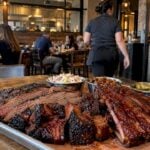
Joe’s Kansas City Bar-B-Que sits inside a working gas station at 3002 W. 47th Ave., Kansas City, KS. The burnt ends here are the standard every other KC pitmaster measures against. Pitmasters remove the brisket point, smoke it alongside pork butts for 15–17 hours so the dripping pork fat bastes the beef, then cube each slice to preserve the bark on every single piece. They arrive without sauce, paired with Texas toast and a side of barbecue beans or KC “caviar.”
The line forms before the 11 AM open, especially on Fridays. Parking is tight in the gas station lot. Burnt ends sell out most days by early afternoon, so arriving early is recommended. Expect to pay a moderate price for a plate.
2. Burnt ends at Arthur Bryant’s Barbecue
Arthur Bryant’s Barbecue at 1727 Brooklyn Ave. in the 18th and Vine district takes a different approach. Whole brisket is smoked over hickory and oak for roughly 12 hours, chilled for two days, then returned to the smoker for another six. The result is a bark that reduces the brisket by half or more, and the cubed burnt ends here are tossed in sauce rather than served dry. That’s the key difference from Joe’s.
The room is no-frills, the line moves fast, and the neighborhood carries real KC history. Arthur Bryant’s traces its lineage directly to Henry Perry, the pitmaster who opened Kansas City’s first brick-and-mortar barbecue restaurant in 1910. Budget a moderate amount for a burnt ends sandwich.
3. Z-Man sandwich at Joe’s Kansas City Bar-B-Que
The Z-Man is smoked beef brisket layered with smoked provolone, caramelized onions, and barbecue sauce on a Kaiser roll. It’s the dish that convinced a generation of KC eaters that the city’s food identity extends past the burnt ends plate. Same address as above: 3002 W. 47th Ave.
Order it at the counter alongside a side of spicy slaw. The Z-Man is priced moderately and holds together better than it looks. If you’re going to eat one sandwich in Kansas City, this is the argument.
4. Pork tenderloin sandwich at Kitty’s Café
Kitty’s Café at 4324 Belleview Ave. in Midtown is cash only, seating is limited, and the courtyard picnic tables fill up fast on warm afternoons. The pork tenderloin here is three tempura-breaded cutlets stacked vertically inside a soft, buttery bun. That preparation dates to founders Paul and Kitty Kawakami, who opened the restaurant in 1951 after leaving a Japanese internment camp. The vertical stack preserves an airy crunch that a flattened Midwestern tenderloin simply cannot replicate.
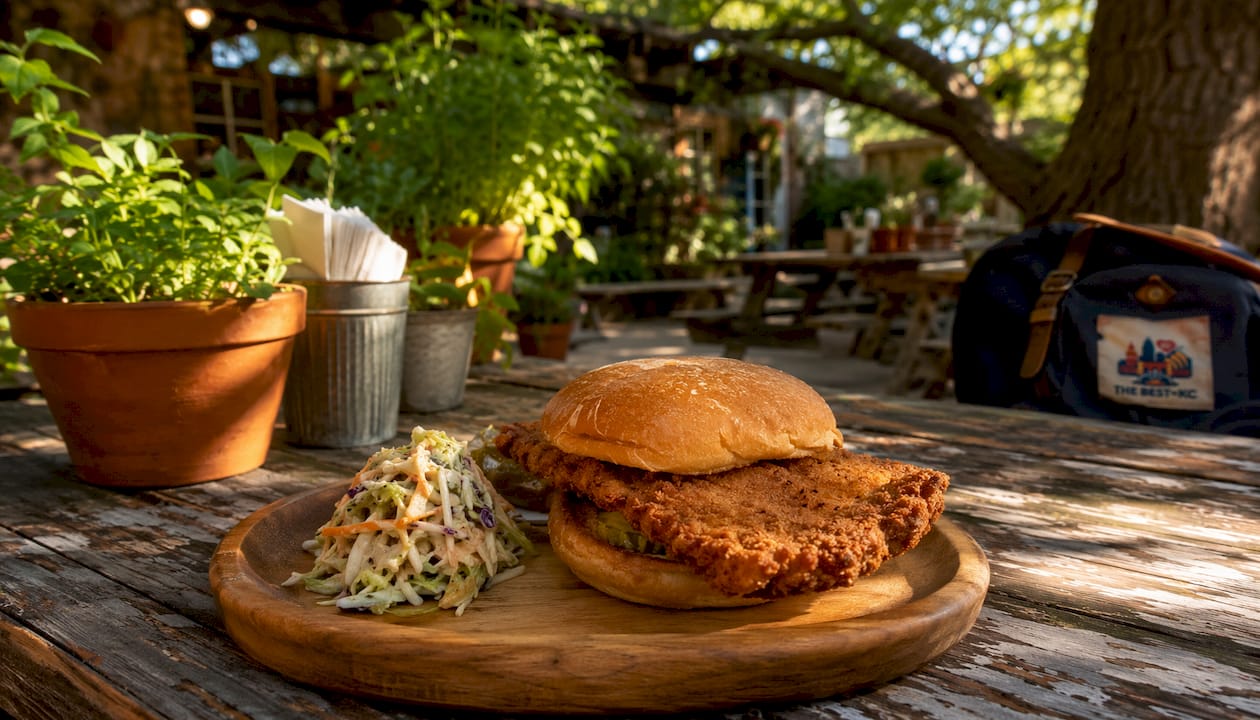
Pro Tip: If you don’t eat pork, the catfish tenderloin uses the same tempura technique and is worth ordering on its own merits.
Bring cash, expect a short wait at lunch, and plan to grab a seat outside. The sandwich is priced moderately.
5. Cheese slipper at Ibis Bakery / Messenger Coffee Co.
Ibis Bakery operates its Cheese Slipper Night out of Messenger Coffee Co. at 1624 Grand Blvd. in the Crossroads district, on First Fridays during the warmer months. The bread is ciabatta loaded with Tillamook medium aged cheddar, Alma Creamery smoked cheddar, Cedar Grove garlic cheese curds, and seasonal produce sourced from local growers like Crum’s Heirlooms in Bonner Springs. Two varieties are always available: one with meat, one vegetarian.
The event is weather-dependent and ingredient-driven. Flavors rotate weekly and are announced on social media, so following Messenger Coffee Co. before you go is the only way to know what’s on. Doors open at 6 PM; the slippers sell out. Price runs at a moderate range per loaf.
6. Fried chicken at Stroud’s
Stroud’s has multiple KC locations, with the original at 5410 NE Oak Ridge Dr. in the Northland. The fried chicken is pan-fried, not pressure-cooked, and every dinner comes with cinnamon rolls as a standard side. That combination is specific to Stroud’s and has been part of the menu for decades. The chicken has a thick, craggy crust and a juicy interior.
Weekend waits can stretch to 45 minutes without a reservation. The dining room is loud and family-style, which is part of the appeal. A full chicken dinner with sides is moderately priced.
7. KC strip steak at The Golden Ox
The Golden Ox operates inside the historic Livestock Exchange Building at 1600 Genessee St. in the West Bottoms. The Kansas City strip steak was born here: a bone-in cut tied directly to the city’s stockyard history. The room has been restored but keeps its midcentury character, and the menu still runs steakhouse classics like oysters Rockefeller and thick-sliced onion rings.
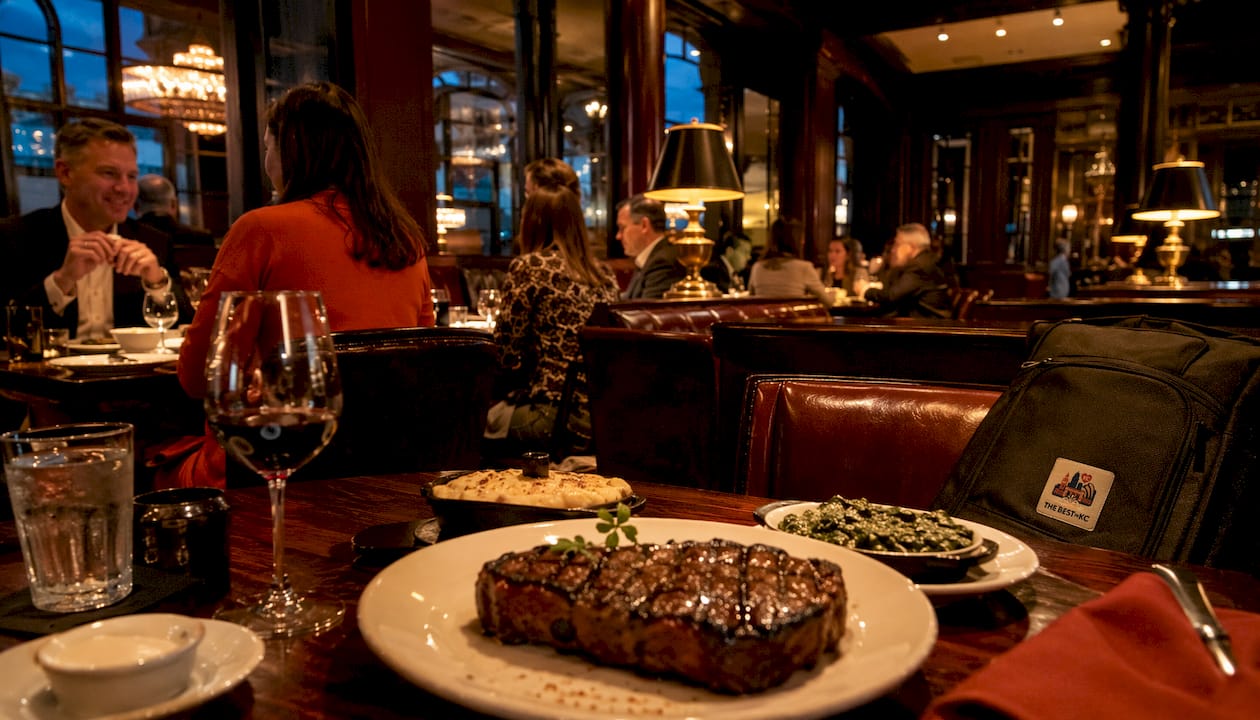
Dinner reservations are recommended on weekends. A KC strip runs at prices typical for upscale steakhouse cuts depending on the cut. The West Bottoms location means parking is easy, which is not something you can say about most KC dining destinations.
8. Roller dogs at QuikTrip
QuikTrip roller dogs are a genuine KC food institution. The hot dogs rotate continuously on a conveyor and are available at every QuikTrip location across the metro, 24 hours a day. They’re beloved for convenience and flavor in a way that no other convenience-store food item in the city has matched. Price is typically under $2.
The closest comparison in other cities doesn’t land the same way. KC locals treat a QuikTrip roller dog as a legitimate food stop, not a fallback. Order two, add the jalapeño cream cheese dip, and don’t apologize for it.
9. Dixon’s chili at Dixon’s Famous Chili
Dixon’s Famous Chili at 9105 E. US-40 in Independence has been serving its thick, spiced chili since 1919. The recipe is proprietary and the bowl is dense, not soupy. Dixon’s chili is one of the dishes that comes up every time KC food people debate what defines the city’s table beyond barbecue.
A bowl runs under $10. The location is east of downtown, so it’s a deliberate trip rather than a walk-in. That’s fine. Dishes worth eating are worth driving for.
10. Waldo Pizza
Waldo Pizza at 7433 Broadway Blvd. in the Waldo neighborhood has anchored its block for years. The pizza here leans toward a thicker, crispier crust with generous toppings, and the neighborhood crowd treats it as a weekly ritual rather than an occasion. It’s the kind of place where regulars have a usual order.
The dining room fills up on Friday and Saturday evenings; arrive by 6 PM or expect a wait. A large pizza is priced at a moderate range depending on toppings.
11. Competition-style BBQ at Q39
Q39 at 1000 W. 39th St. in Midtown brings a competition barbecue approach to a sit-down restaurant format. The menu covers ribs, brisket, and pulled pork, all slow-smoked and served with a thick tomato and molasses-based sauce that defines KC barbecue. Q39 is the place to bring out-of-town guests who want a full-service BBQ experience rather than a counter line.
Reservations are accepted and worth making on weekends. A full plate with two sides is priced moderately. The Midtown location has better parking than most of the city’s barbecue institutions.
How Kansas City’s signature dishes got here
Kansas City’s food identity was built by a single person before it became an industry. Henry Perry arrived from Memphis in 1907, opened a food cart in the Garment District in 1908, and by 1910 was running what historians credit as the city’s first brick-and-mortar barbecue restaurant at 1514 East 19th Street. He smoked everything over hickory and oak with a vinegar-pepper sauce, and he trained three apprentices who went on to found Gates Bar-B-Q and Arthur Bryant’s.
The numbered evolution of KC’s culinary identity looks roughly like this:
- 1907–1910: Henry Perry establishes the KC barbecue method, slow-smoking over hickory and oak.
- 1946–1958: Arthur Bryant takes full control of the family restaurant, relocates to Brooklyn Avenue, and refines the sauce.
- Early 1990s: The competition barbecue circuit formalizes burnt ends as a distinct dish, not just brisket trimmings.
- 1951: Paul and Kitty Kawakami open Kitty’s Café, introducing the vertical tempura tenderloin stack.
- 2012: Fred Spompinato at Fervere Bakery creates the cheese slipper, combining house-made ciabatta with local seasonal cheeses.
- 2017: Ibis Bakery and Messenger Coffee Co. revive Cheese Slipper Night in the Crossroads district.
“Burnt ends were born in Kansas City, and you won’t find any better in the world.” — Feast Magazine, on the dish’s origins with Henry Perry and Arthur Bryant
Kansas City barbecue is defined by variety: ribs, beef brisket, burnt ends, and pulled pork, all slow-smoked over hickory and oak and served with a thick tomato and molasses-based sauce. What separates KC style from Texas or Carolina is the sauce and the range of proteins. Texas leans beef and dry rub; Carolina pulls toward vinegar and pork. KC does both, adds the sauce, and invented burnt ends as a category.
The cheese slipper story is a good example of how KC food culture works outside barbecue. Ciabatta means “slipper” in Italian, and Spompinato played on that when he started selling cheese-loaded loaves on summer Saturday nights. The Cheese Slipper Night tradition passed from Fervere to Ibis Bakery in 2015 and moved to the Crossroads in 2017, where it now runs as a community event tied to First Fridays and local producers like Crum’s Heirlooms.
What makes the cheese slipper a Kansas City original
The cheese slipper is not a pizza and not a flatbread. It’s a ciabatta loaf baked with cheese mixed directly into the dough, using a recipe built on house-milled flour, organic wheat starter, olive oil, and sea salt. The cheese load includes Tillamook medium aged cheddar, Alma Creamery smoked cheddar, and Cedar Grove garlic cheese curds, with seasonal produce folded in depending on what local farms are producing that week.
Fred Spompinato created the original recipe at Fervere Bakery on the Westside around 2012. When he sold the bakery to Ibis Bakery owners Chris and Kate Matsch in 2015, the recipe and the tradition transferred with it. Since 2017, Cheese Slipper Night has run at Messenger Coffee Co. on First Fridays, with two varieties always available: one meat, one vegetarian. Previous combinations have included apple cider chicken with Brussel sprouts and BBQ sweet potatoes with jalapeño cornbread crumbles.
The event is hyper-seasonal. Ingredients rotate weekly based on what’s available from local producers, and the lineup is announced on social media a few days before each Friday. A team of five handles the prep, which starts four hours before doors open at 6 PM. Get there early or you’ll leave empty-handed.
The Best in KC has the local shortlist you actually need
The best KC food experiences go deeper than any single dish. The Best in KC is a local guide written by people who’ve eaten at these places, know which nights to avoid, and can tell you where to park at The Golden Ox. Every list on the site covers KCMO and the Kansas side, with first-person picks, exact addresses, and the kind of detail you only get from showing up.
If you want to eat your way through the city with a real local’s shortlist, the KC walking and bus tours guide is the fastest way to connect the dots between the Crossroads, 18th and Vine, and the West Bottoms in a single day. No scraped directories, no generic roundups.
Key Takeaways
Kansas City’s signature dishes trace directly to Henry Perry’s 1907 barbecue method, with burnt ends, the Z-Man, the cheese slipper, and Kitty’s tenderloin each representing a distinct chapter in the city’s food history.
| Point | Details |
|---|---|
| Burnt ends origin | Henry Perry established KC’s hickory-and-oak smoking method in 1907; burnt ends formalized in the competition circuit by the early 1990s. |
| Kitty’s tenderloin | Three tempura-breaded cutlets stacked vertically since 1951; cash only, limited seating at 4324 Belleview Ave. |
| Cheese slipper | Ciabatta loaded with local cheeses, available only on First Fridays at Messenger Coffee Co., 1624 Grand Blvd. |
| KC BBQ vs. other styles | KC style uses hickory and oak smoke with a thick tomato-molasses sauce across multiple proteins; Texas leans dry-rub beef, Carolina leans vinegar-pork. |
| The Best in KC | Covers all 11 dishes with first-person addresses, ordering tips, and curated food tours across KCMO and the Kansas side. |